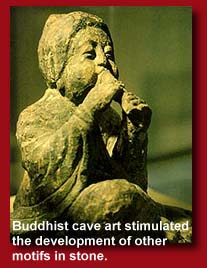
The Pinyang Caves, begun in 500, have generally
been regarded as the most complete of the giant caves at Lungmen. Here,
relief images of emperors and empresses advance to pay their respects to
the Buddha. Their f'acial expressions are especially calm and sincere.
Unlike the small niches in the Kuyang Caves, all the images carved on the
inside walls of the Pinyang caves are quite large.
The Northern Wei style continued into the time of the Eastern Wei (534-550) and Western Wei (535-557). The five Kunghsien Caves on the cliff's of Mt. Mang near Loyang are representative of this period. The images look like those of the Lungmen Caves, with narrow faces, high brows, large eyes, and smiling mouths. But the pleats of their robes have lost their shaped, angular character. The treatment of drapery becomes mechanical and repetitive, and the countenances of the images seem milder.
During the Northern Ch'i (550-577), a different style of sculpture in rock emerged. The cave temples of Hsiangtangshan, situated on the border of Hopeh and Honan Provinces, best represent the style of the period. They appear uncomplicated, cleaner, more natural. The mood is calm, and the bodies of both the Buddha and bodhisattvas are stronger and more muscular. Faces, under heavily-coiled hair, are more squared in shape, and heavy and honest. Some images have a halo behind the head. The robes fall in loose pleats, covering the body without particular intention to shape. But the robes are elegant, with a clearly-defined hem-a trademark of the Northern Ch'i style. The Hsiangtangshan rock sculptures show another evolution. Facial features now appear more like northern Han people. The Buddha has become Chinese.
During the Sui (581-618), few new stone caves were constructed. But sculptors carved numerous small images at caves already constructed during the Northern and Southern Dynasties, such as Lungmen, Tienlungshan, Tunhuang, and the Yuhanshan caves in Shantung Province.
Generally speaking, the style of the Northern Ch'i Dynasty continued
in the Sui Dynasty. The shapes of eyes, nose, and mouth give the figures
an agile intelligence. The bodies of Bodhisattvas are ornamented with heavy,
luxurious jewelry, a popular motif during the period. The facial features
and expressions of the Sui Dynasty illustrate a time of transition, with
their sharply delineated eyes and strong-willed mouths. Images of the Dynasty
appear stern, more powerful than mystical. Inevitably, Buddhism and its
art were gradually altered by their encounter with Chinese culture. Elegance,
illustrated in the Sui devotional images, became a special feature of Chinese
Buddhist sculptures. 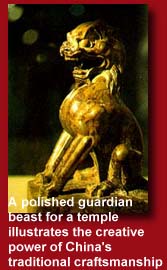
By the T'ang Dynasty (618-906), a complete Chinese-style Buddhist art was created, and it bloomed in f ull. Buddhism developed to unprecedented heights under the friendly patronage of the ruling families and with the support of all segments of society. As a result, T'ang-style Buddhist images are distributed widely in China, and appear in large numbers. T'ang figures are generally more realistic in expression, and they convey a calm inner spirit. The dynasty was a time of relative peace, and the arts flourished. Rulers and people alike revealed their passions and confidence in literature, and in the arts of Buddhism as well. Oftentimes stone sculptures of the period have a friendly intimacy mixed with a gentle, magnanimous spirit.
The Tienlungshan Caves, located near Taiyuan, Shansi Province, and constructed during the reign of Empress Wu (625-705) and Emperor Hsuan-tsung (712-755) of the T'ang Dynasty, illustrate T'ang Buddhist art at its best. A trend toward smaller images had begun, and these figures rarely exceed one meter in height. The figures are warm and friendly, and the bodhisattva images in particular have a refined beauty.
Buddhist art can be found throughout the vast territory of China. For centuries, from the Northern and Southern Dynasties, the Sui, and the T'ang down to the Sung and Ming Dynasties, patrons of the religion built stone temples, carved into cliffs, and made individual statues. Even though Buddhist cave sculptures have been damaged over a thousand years by either natural or man-made disasters, especially during the past three decades, much of. their beauty remains. The magnificent Buddhist ar.t of China-borrowed, adapted, then refined-indicates the strength of Chinese culture, enduring and evolving by responding to foreign as well as internal stimuli.

Ancient Bronzes:
Early Design Elegance
Bronze Mirrors: Aesthetic
Reflections
Buddist Caves: Compassionate Serenity
Stone Collecting: Miniature
Landscapes
Snuff Bottles: Art In Small
Packages
Embroidery: Meticulous
Masterpieces
for questions and comments please send to liaoless@iii.org.tw

publisher: Kuo Wei-fan
Organizer: Council Cultural Affairs and Development, Kwang Hwa Publishing
Company
Supervisor: Liu Li-min
Coordinators: Huang Su-Chuan, Yiu yu-fen
Managing Editor: Chen Wen-tsung
Editor: Richard R. Vuylsteke
Reader: Ching-Hsi Perng
Published by the Council for Cultureal Affairs
Executive Yuan Republic of China