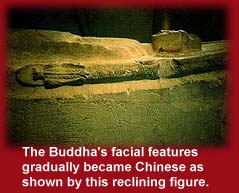
Of the Southern Dynasties, Emperor Liang-su
contributed the most to the propagation of Buddhism. But the works in southern
China do not compare with the quality of the stone sculpture in the north,
in large part due to the lack of appropriate rock precipices suitable for
carved Buddhist icons. Nevertheless, craftsmen in southern China distinguished
themselves by large-scale building of Buddhist temples and sculpture work,
especially during the reign of Emperor Wu of the Liang Dynasty.
Opposition to the new religion existed during both the Southern and Northern Dynasties, and this had an impact on the caves. Emperor T'ai-wu of the Northern Wei, in 446-452, and Emperor Wu of the Northern Chou, during 574-577, decreed the destruction of all Buddhist images and scriptures. But others resisted these decrees, and as part of the resistance to the religous persecutions, the five Tanyao caves at Yunkang were carved during the reign of Emperor Wen-ch'eng of Northern Wei. Thus, while the two emperors' persecutions certainly constituted a blow to the development of Buddhism, they also resulted in its large-scale establishment.
A pproximately 10 miles west of Tatung, Shansi Province, the village of Yunkang is situated at the foot of the steep slopes of Mt. Wuchou, near the Wuchou River. The craggy sandstone terrain on the northern bank of the river extends for one mile, east to west. Grottoes sheltering stone images of the Buddha and Bodhisattvas were chiseled out all along the southern reaches of this area.
The first and most important grouping of Yunkang caves are the five
Tanyao caves, which were created by sculptors under the supervision of
Monk Tanyao. Each cave has a giant stone figure of the Buddha, more than
10 meters high. It is said that the caves were Emperor Wen-ch'eng's commemoration
of the five previous emperors. Started in 460, in new fervor and in expiation
for the Buddhist persecutions of 446-452, the cave chapels at Yunkang were
built under imperial orders. The Northern Wei domain was ruled by the North
China Topa people, considered barbarians by the Chinese. It was not until
the 6th Century that the Topa came under the full influence of Chinese
culture. 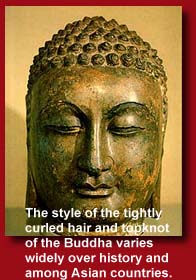
Therefore, the Yunkang rock sculptures show the importation of influences stemming f'rom Gandhara and Central Asia.
The lines and surfaces of these early colossal images at Yunkang are uncomplicated, cut in accordance with the principles of naturalism, not formalism. All have imposing bodies, broad shoulders, thick lips, big ears, stout necks, and plump cheeks. They always gaze toward the front. The body of the images is usually symmetrically arranged and, although the figures are smiling, their faces have a rather majestic spirit. During the latter phase of the Yunkang Caves, the bodies of the images become more slender and appear more geometric. The faces have a pointed look, characterized by narrowness and a high arch to the eyebrows.
After the Northern Wei people transferred their court to Loyang in 495, they started to search for a site near the city to create sculptures of greater grandeur than those at Yunkang. They found an appropriate place at Lungmen, 15 miles south of the city of Loyang, an area created by two chains of small mountains which cradle the Yi River.
The f'amous Lungmen Caves are carved into stone clif'fs along both banks of the Yi River, although most of the 28 giant caves built during the Northern Wei are on the west bank. Those carved during the T'ang Dynasty (including seven giant caves) are on the east bank. Af'ter the end of the Northern Wei Dynasty, construction activities stopped for a while. But during the Sui Dynasty (581-618) and T'ang Dynasty (618-906) work was resumed on a large scale.
Of the 2,137 caves at Lungmen, about one-third were carved during the Northern Wei Dynasty. The Lungmen clif'f's are fine, hard limestone, and are much better suited f'or the carving of detailed images than the loose, sof't sandstone of Yunkang.
Af'ter moving its capital, the Northern Wei Dynasty gradually came under the influence of' Chinese culture, leading to the disappearance of' the the Yunkang style of sculpture, a f'orm that joined the undaunted, gallant spirit of the Topa people, who had founded the dynasty, with the carving skills of Western Asian sculptors. Lungmen figures characteristically have loose broad-sleeved robes, giving them an exquisite, graceful quality. The lines are more sophisticated and have a sense of rhythm. The art of stone sculpture reaches its zenith in the Northern Wei Dynasty with the Lungmen Caves.
The first group of caves constructed at Lungmen are the Kuyang Caves,
begun in 495 A.D. They are 13 meters deep, 11 meters high, and seven meters
wide. Most of the Buddhist niches bear dated inscriptions, which indicate
that the cave carvings were supported by the royal family, officials, monks,
and religious societies. The chief images at the Kuyang Caves are of Sakyamuni
Buddha and bodhisattvas. Above these are smaller images, resting in three
rows of symmetrical niches.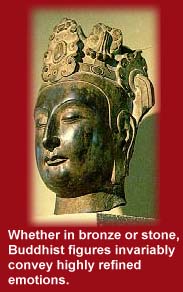
Kuyang images have a slender appearance, with long, regularly-pleated gowns with wide sleeves. These naturally hanging garments replace the more tightly adhering garments in the Yunkang style. Also, f'acial expressions have changed from the blissfully serene to become more graceful, and natural.
After the construction of the Kuyang Caves, the imperial family continued
its patronage by financing the carving of the Pinyang Caves at Lungmen.
It reportedly took 23 years to chisel the three Pinyang Caves, although
the major Buddhist sculptures of' the first two caves were not completed
until 641, during the T'ang Dynasty.


Ancient Bronzes:
Early Design Elegance
Bronze Mirrors: Aesthetic
Reflections
Buddist Caves: Compassionate Serenity
Stone Collecting: Miniature
Landscapes
Snuff Bottles: Art In Small
Packages
Embroidery: Meticulous
Masterpieces
for questions and comments please send to liaoless@iii.org.tw

publisher: Kuo Wei-fan
Organizer: Council Cultural Affairs and Development, Kwang Hwa Publishing
Company
Supervisor: Liu Li-min
Coordinators: Huang Su-Chuan, Yiu yu-fen
Managing Editor: Chen Wen-tsung
Editor: Richard R. Vuylsteke
Reader: Ching-Hsi Perng
Published by the Council for Cultureal Affairs
Executive Yuan Republic of China