Compassionate
Serenity In Stone(page 1)
BY BETTY WANG
PHOTOS BY JENNIFER CHU
The earliest known Buddhist caves in China
are at Pingling Temple and Tunhuang in present-day Kansu Province. They
were begun during the Western Chin (385-434) and the Northern Liang (401-439)
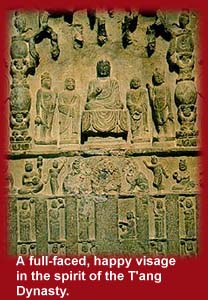 Dynasties and the Sixteen
States Period (304-439). By the 13th Century, Buddhist caves could be found
in a dozen provinces. From those at Tatung in Shansi Province and Loyang
in Honan Province, which are considered the center of cave development,
Buddhist caves can be found along three routes moving toward the downstream
regions of the Yellow River. The northeastern line extends from Hopeh to
Shantung, reaching as far as Liaoning; the southwestern route includes
Honan, Shensi, and Kansu, and fans out toward Sinkiang, Szechwan, Yunnan,
and Kwangsi. And the southeastern route extends to Kiangsu and Chekiang
Provinces.
Dynasties and the Sixteen
States Period (304-439). By the 13th Century, Buddhist caves could be found
in a dozen provinces. From those at Tatung in Shansi Province and Loyang
in Honan Province, which are considered the center of cave development,
Buddhist caves can be found along three routes moving toward the downstream
regions of the Yellow River. The northeastern line extends from Hopeh to
Shantung, reaching as far as Liaoning; the southwestern route includes
Honan, Shensi, and Kansu, and fans out toward Sinkiang, Szechwan, Yunnan,
and Kwangsi. And the southeastern route extends to Kiangsu and Chekiang
Provinces.
Founded in India during the 6th Century B.C., Buddhism remained in the
valley of the Ganges River for two centuries before it began moving to
other parts of Asia. Near the beginning of the Christian era, during the
Han Dynasty (206 B.C.- 219A.D.), Buddhism entered the populous, civilized
centers of China and began a steady, if sometimes slow and halting, expansion
throughout the country. Although the exact route Buddhism took into China
remains unknown, it is generally accepted that emissaries, worshippers,
or other proselytizers of the religion came from the northwest by the Silk
Road, stopping at Tunhuang and eventually at Loyang, the Latter Han capital.
With the fall of the Han Dynasty in 220 A.D., China entered a period
of disunity lasting until 589. During the final years of the Western Tsin
Dynasty (265-316 A.D.), the Chinese foothold in North China became highly
tenuous, especially after the Huns captured the city of Loyang in 311 and
the city of Changan in 316. The fall of these two centers of Chinese civilization
marked the end of Chinese suzerainty in the northern part of China for
almost three centuries, and forced the emigration of literati, officials,
and learned Buddhist monks from northern China to settlements in the south
near the present Nanking.
These refugees helped establish the Eastern Tsin Dynasty (316-419) and
maintained a determination to recapture northern China and restore the
supremacy of Chinese culture over the whole country. But they must have
had grave doubts about their chances of success, since they had lost the
heartland of Chinese culture. To some extent, these uncertain conditions
encouraged acceptance of the "foreign" religion of Buddhism.
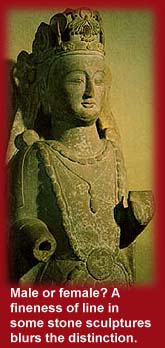
Because the royal household in southern China was weak at this time,
the Buddhist community was able to assert its independence of secular authority.
At the same time, the rulers in northern China, who were non-Chinese in
the midst of a large Chinese population, found it expedient to adopt a
religion that was not caught up with Chinese cultural ramifications. As
a result, Buddhism became a state religion in northern China.
After the demise of the Eastern Tsin in 420, the Liu Sung Dynasty (420-479)
was established in southern China, while northern China, beginning in 440,
was unified under the Northern Wei Dynasty (386-534). Thus began the era
called the Northern and Southern Dynasties. During this period, Buddhism
was gradually accepted both by Chinese and non-Chinese rulers and by the
masses.
The spirit of the times led to the desire for more tranquil lives and
wishes to be freed of the world's turmoil. Buddhism was therefore very
appealing, and found eager and ready converts. With the movement of Buddhist
doctrine from India came the belief that the creation of Buddhist images
and cave temples was a means to win blessings. The whole country, especially
rulers and wealthy families, began financing the carving of thousands of
devotional images and structures out of rock in hopes of earning merit
for the afterlife.
As a result of imperial patronage, the Northern Wei Dynasty is often
credited with beginning the art of cave sculpture in China. Emperor Wen-ch'eng
of the Northern Wei directed the carving of the first five imperial caves
(Caves 16 to 20) at Yunkang. Emperor Hsiao-wen of the same dynasty followed
with the Kuyang and Pinyang Caves in Lungmen.

CONTENTS
Foreword and Preface
Ancient Bronzes:
Early Design Elegance
Bronze Mirrors: Aesthetic
Reflections
Buddist Caves: Compassionate Serenity
Stone Collecting: Miniature
Landscapes
Snuff Bottles: Art In Small
Packages
Embroidery: Meticulous
Masterpieces
for questions and comments please send to liaoless@iii.org.tw

publisher: Kuo Wei-fan
Organizer: Council Cultural Affairs and Development, Kwang Hwa Publishing
Company
Supervisor: Liu Li-min
Coordinators: Huang Su-Chuan, Yiu yu-fen
Managing Editor: Chen Wen-tsung
Editor: Richard R. Vuylsteke
Reader: Ching-Hsi Perng
Published by the Council for Cultureal Affairs
Executive Yuan Republic of China