 (1271-1368)
as a result of cultural interactions between China and the Central Asia,
most probably through traders, missionaries, or traveling craftsmen. But
the more advanced technique of picture-painting on the enamel came much
later, at the beginning of the 18th Century during the reign of Kang-hsi.
Such painted enamel appeared simultaneously in Canton and Peking, and with
imperial patronage its popularity developed rapidly.
(1271-1368)
as a result of cultural interactions between China and the Central Asia,
most probably through traders, missionaries, or traveling craftsmen. But
the more advanced technique of picture-painting on the enamel came much
later, at the beginning of the 18th Century during the reign of Kang-hsi.
Such painted enamel appeared simultaneously in Canton and Peking, and with
imperial patronage its popularity developed rapidly. 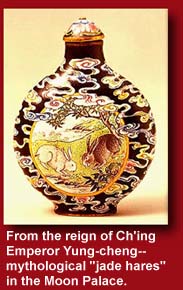
Emperor Kang-hsi especially appreciated 15th Century enamels from Flanders, and toward the latter years of his 60-year reign, he invited the Jesuit priest Jean Baptiste Cravereau to Peking to teach the technique to Chinese artisans. In letters to their superiors in Rome, the priests mentioned a need f'or more such enameling masters to come to China. As a result, this medium-which was generally neglected by Western artists after the 16th and 17th Century-found new and influential admirers in China.
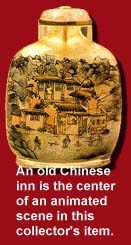
One of the frequent motifs used on snuff bottles produced during the reign of Emperor Chien-lung is the mixing of Chinese themes with Western scenery and portraits, producing both exotic and delightful results. Jesuit priests such as Fathers Castiglione and Attiret were consigned by the emperor to do sketches for artisans, who would then copy them on enamel snuff bottles. This process introduced the Western "solid perspective" technique to China.
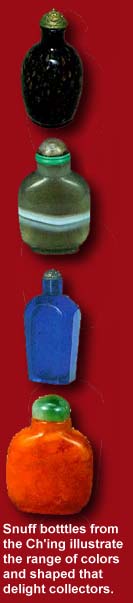
Among the great rarities on the international antique market are snuff bottles from Yi-hsing, on the western shore of Lake Tai Hu in Kiangsu Province, a locale also famous for its teaware. It may seem peculiar that snuff bottles of clay could compete in value with those of glass, enamel, jade, ivory, and precious stones. In fact, many experts say that Yi-hsing snuff bottles leave much to be desired in the way of artistic designs and glazes. But the Yi-hsing bottle, like the teaware, was known f'or its excellence in preserving the aroma and flavor of its contents. As time passed, the law of supply and demand made these humbler bottles of fired clay also highly valued.
Antique markets aside, today's ordinary viewer-East or West-can take
great pleasure in the shapes and designs of these miniature works of art.
The snuff bottle is a delightful example of a mundane functional object
rising to the heights of aesthetic refinement.

Ancient Bronzes:
Early Design Elegance
Bronze Mirrors: Aesthetic
Reflections
Buddist Caves: Compassionate
Serenity
Stone Collecting: Miniature
Landscapes
Snuff Bottles: Art In Small
Packages
Embroidery: Meticulous
Masterpieces
for questions and comments please send to liaoless@iii.org.tw

publisher: Kuo Wei-fan
Organizer: Council Cultural Affairs and Development, Kwang Hwa Publishing
Company
Supervisor: Liu Li-min
Coordinators: Huang Su-Chuan, Yiu yu-fen
Managing Editor: Chen Wen-tsung
Editor: Richard R. Vuylsteke
Reader: Ching-Hsi Perng
Published by the Council for Cultureal Affairs
Executive Yuan Republic of China