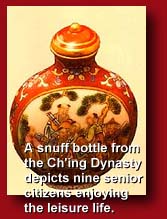
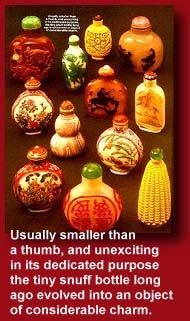
With the passing of the Chinese imperial dynasties, the snuff bottle at first fell into a historical shadow, at least when compared with other Chinese antiquities. But in recent years it has regained its popularity, and collectors are willing to pay handsome prices for outstanding examples of this tiny antique.
Exquisite examples of snuff bottles can draw expansive praise from collectors. "True lovers of snuff bottles learn to feel with the eyes, see with the hands, and taste with the mind," one collector says. "Make your mind blank, as in Zen meditation, and a form of peaceful communication begins between yourself and the beauty of the object."
The snuff bottle has its roots in 17th Century Europe, where high society preferred to take snuff rather than smoke tobacco. While it was considered quite polite to inhale a pinch of the finely pulverized tobacco, smoking tobacco in other forms was considered offensive. In fact, when the act of drawing a pinch of snuff up the nostrils was performed properly, the subsequent sneeze demonstrated exceptional social grace.
The exact time of the introduction of snuff to China is not known, but according to the Ch'ing Dynasty scholar and calligrapher Chao Chi-chien, Father Matteo Ricci was the first European to introduce snuff to the Middle Kingdom. Among the gifts Ricci presented to Ming Dynasty Emperor Shen-tzung in 1581 was a snuff box and a sample of superior snuff. Chao's story is contradicted somewhat by other historical records, which indicate that Ricci was not allowed to enter the Imperial City to seek an audience with the emperor until 1601.
The word "snuff' first appeared in official Chinese documents in 1684, when Ch'ing Dynasty Emperor Kang-hsi made his first trip to the southern part of China. After arriving at Nanking, the Emperor gave an audience to the Jesuit priests Joannes Cabiami and Joannes Valat. Among four gifts presented by the priests, Kang-hsi is reported to have acknowledged with pleasure the receipt of snuff, but he returned the other gifts on the grounds that they were "too rare" to be given away.
The origin of snuff bottles need not be traced in the West. After Chinese elites adopted the use of snuff; they sought better ways to preserve its aroma and flavor. Fortunately for today's collectors, Western snuff boxes proved inadequate in the humid weather of Asia. Chinese craftsmen responded to the need by designing small, air-tight bottles to hold the finely-ground tobacco. Thus, the snuff bottle was born.
Actually, snuff bottles were adapted from similar containers used for
other purposes. They evolved from the small medicine bottles commonly used
during the Ming Dynasty. It was therefore not a mere coincidence that the
people of the Ming and Ch'ing Dynasties also considered snuff a medicine,
effective for toothaches and for easing such respiratory problems as colds,
coughs, and asthma. Snuff was also believed to be a digestive aid and good
for the appetite (although none of these merits has been medically verified).
The only sure benefit from taking snuff is that it provides an enjoyable
diversion, and perhaps some psychological relief from the pace of the "good
life."
In any case, the snuff bottle soon became an object of artistic focus in China because of the patronage of several Ch'ing emperors, including Kang-hsi, who became regular users of snuff. Since Kang-hsi was an enthusiastic patron of the arts; snuff bottle design also benefited. By 1693, the 32nd year of Kang-hsi's reign, 14 imperial workshops were operating in the Forbidden City. These recruited skilled artisans from all over the country to cultivate various art forms, including snuff bottles.

Ancient Bronzes:
Early Design Elegance
Bronze Mirrors: Aesthetic
Reflections
Buddist Caves: Compassionate Serenity
Stone Collecting: Miniature
Landscapes
Snuff Bottles: Art In Small
Packages
Embroidery: Meticulous
Masterpieces
for questions and comments please send to liaoless@iii.org.tw

publisher: Kuo Wei-fan
Organizer: Council Cultural Affairs and Development, Kwang Hwa Publishing
Company
Supervisor: Liu Li-min
Coordinators: Huang Su-Chuan, Yiu yu-fen
Managing Editor: Chen Wen-tsung
Editor: Richard R. Vuylsteke
Reader: Ching-Hsi Perng
Published by the Council for Cultureal Affairs
Executive Yuan Republic of China