| Window of Interview:
Date: July 17, 1996
Place: Workshop of Image Labo Tecst on the Niyodo River in Ino Town
Mr. Kato, sticking to local materials and his original landscape, completes goods with strict eyes. He actively enjoys his role as an industrial designer living in the country. He returned to Kochi after working in a large city. "If there is nothing you like, you can creat one for yourself"is his motto. This way of thinking helped him create goods originated in Kochi. The new series of lighting fixtures will be exported by direct sale.
- Why did you choose this place as your workshop?
- "CARTA is basically on the line of Tosa Washi. We use Kozo, a paper mulberry, which is one of the materials of Tosa Washi. It is difficult to define Tosa Washi, but the main feature of Tosa Washi is that it is Kozo paper. "CARTA is one of our products that make the best characteristics of Kozo. The place with abundant Tosa Washi cuture is here, the valley of the Niyodo River in Ino Town. Also, many of the experts on paper live around here. So, I chose this location from a point of geographical advantage.
"CARTA"has a subtitle,"Lighting of Ino-Gami."
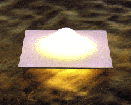 - Paper called Tosa Washi doesn't actually exist, and"Ino-Gami (paper)"is more popular with professional people. Though Ino-Gami is a dead word now, I have a good memory of it. When I was a child, paper mulberry grew even in a very narrow land in Ino Town. People of Ino lived on paper. The Niyodo River helped develop the paper industry. That's why I don't want to use"Tosa Washi"so easily.
Photo Lighting of Ino-Gami, TECST CARTA
I think it difficult to make finished products in Kochi. What made it possible?
- From a point of industrial design, Tosa Washi is nothing but a material. It is very difficult for us living in Kochi to make and distribute finished products which must satisfy safety standards and regulations. As far as lighting fixture is concerned, there is no producer at all in Kochi. Since there is no JIS-adopted factory in Kochi, we cannot make bases for lighting fixture here and have to order them by OEM from factories in Tokyo or Kanagawa. Even if I were a papermaker or a designer who grew up in Tokyo, I couldn't be successful in making cubic paper. The point is that I am a child of a paper-producing district. When I returned to Kochi, I couldn't find any place to work in. So, I thought I should do it myself, because materials are always here with me.
The characteristics of CARTA lie in a unique method of cubic papermaking. What do you think of this method?
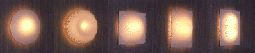 - We don't focus on that point at all. Rather, we would like our customers enjoy our lighting fixture because of its design and material. I don't think our products are valuable because they are made cubically.
Photo New TECST CARTA
You are developing the CARTA series, aren't you?
- Maintaining the same basic concept and identity, we are now producing completely different lighting fixture. Even a frame's edge is curved so that light can reflect all over the frame evenly. Also, we now have a line of stand type in addition to a wall type.
When you ship your products overseas, the phrase"Lighting of Ino-Gami"will go with them.
- That's quite meaningful. I give publicity to Tosa Washi or Ino-Gami every time I have a chance. There are people around me who wonder if paper is made in Kochi. They only think of Mino or Echizen when it comes to paper. I often take an example of Nippon Kodoshi Corporation. When I say they make 70 percent of the world's electrolytic capacitor paper here in Kochi, engineers of electronics will surely be astonished.
They don't appeal Kochi outwardly.
- Local industries shouldn't look inward. That company never mentions Tosa Washi, but has basically been influenced by it. They did investigate Tosa Washi thoroughly and now they are making products that are contributable in modern society. The paper they make is beneficial to the people all over the world. I envy them as an ideal model of industrial company.
 Isn't it unusual to use natural materials for lighting fixtures? Isn't it unusual to use natural materials for lighting fixtures?
- Washi is the least material that industrial designers use. Pulp may be used, though. Washi is not industrial because it has problems in delivery time and quality control. What makes Washi differ from plastics or glass is that it doesn't show a light source due to its dull translucence. In this sense, Washi is very advantageous. The ultimate material for lighting fixture is the one that doesn't make a light source show through the material.
When it comes to Washi lamps, Isamu Noguchi is famous.
- When I developed our lighting fixture, I didn't think of Chochin or a paper lantern at all. By the way, do you know where the trial paper for making Gifu Chochin lamps was first made? It was made in Kochi. It was, however, such a fine paper that it cost too much. So, they arranged the paper for more reasonable one in Gifu Prefecture, and now their Chochin lamps have developed into such popular and stable commodities.
The skills of papermakers in Kochi are highly valued on one hand, there is a trend to make finished products like your attempt on the other hand. Do you think both will go together?
- Originally, I thought CARTA should be a work of papermakers. As a designer, I just planned this project as a cooperative work with papermakers. However, it is a matter of course that we gurantee delivery time and stable quality of products, since lighting fixtures always go with architecture. If you don't have much experience, it is difficult to handle this project as an organized business. Once CARTA series appear in a catalog of lighting fixtures, we have a duty to guarantee stable supply of them. If papermakers cannot realize my idea, then it is I, as a planner, that should make CARTA.
Didn't you think of giving up the plan at that moment?
 - We started the project with subsidies of public organization. And, if I have something that I really want other people understand and value, I cannot abandon it halfway. The scale of value sense was fixed at that moment. It was hard for me to decide whether I should give up the plan or I should make CARTA myself. Finally I made a decision to make CARTA myself here because it was I that suggested the plan.
From another aspect, I think people like designers should boost the possibility of paper industry except for the field where each papermaker's skill is valued. It is important to find good points of local materials and make products by developing the materials 100 percent. I thought it a pleasure for me as a designer to be able to practice it.
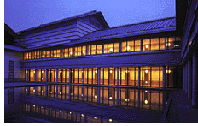
Photo Kochi Art Museum
|




 Come on! Tosawashifreaks.(Newsgroup)