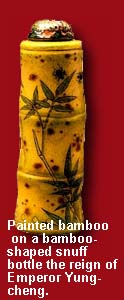

A fine snuff bottle could be a handy conversation piece for new acquaintances, and at other times, according to its value, could help smooth the way for promotion or a special favor. Emperors often used them as tokens of patronage. In the vast Chinese empire, politics was played in a most subtle way. Many things were not articulated openly, and small gift's such as snuff bottles from the emperor or other higher officials of the realm could have substantial symbolic meaning.
Snuff bottles also played a role on the diplomatic scene. The reigns of Emperors Kang-hsi, Yung-cheng, and Chien-lung spanned the prime years of the Ch'ing Dynasty. Foreign missions arriving in China occasioned exchanges of presents-snuff, snuff boxes, and snuff bottles often among them. When Peter the Great of Russia sent ministers to China, f'or example, Emperor Kang-hsi gave each of them a beautifully enameled snuff bottle.
In 1725, Pope Benedictus sent Emperor Yung-cheng many agate and glass
snuff' boxes. As in 17th Century Europe, taking pinches of snuff became
one of the social graces of' China. When friends met on the street or on
social occasions, the first order of business was for one of them to take
a snuff bottle from a pocket in the long, loose sleeve of his robe and
offer the other a pinch. The receiver would conclude the ritual with a
show of appreciation f'or the quality of the gift.
Imperial patronage promoted the refinement of snuff bottle art, for artists and artisans were accorded special favors that ensured their support and encouraged their productivity. For example, a memorial to Emperor Yung-cheng in 1731 specifically indicates the Emperor's pleasure with a swallow motif on an enamel snuff bottle. After inquiring about who was responsible for the design, he directed the distribution of 120 pieces of silver to everyone involved with its production. Today, the value is no less. A fine Ch'ing enamel snuff bottle may well sell for five-figure prices in the antique market.
Imperial support of snuff bottle art also encouraged its development
toward higher levels of delicacy and refinement. But the vitality of the
art gave way gradually to a certain serenity and contentment, then to apathy.
The evolution of art motifs on snuff bottles corroborates this, for a large
portion of them can be categorized under the heading of "aspirations
for good fortune"-for wealth, fertility, immortality, and longevity.
Therefore, it is common to find scenes with the Eight Immortals, the Three
StarGods of Taoism, the dragon-emblem of Imperial power, the phoenix and
hundred children symbols of fertility, the unicorn and tortoise for longevity,
and the fish for wealth and abundance. 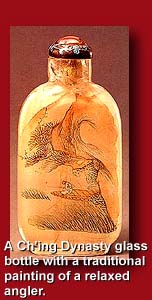
Although it would be inaccurate to say that these designs respond only to the tastes of the upper class, the artistic devotion to such subjects is a reminder that snuff bottles were meant to be an art form for the elites, not for commoners. From the very beginning they were designed with the tastes and interests of emperors, courtiers, and officials in mind.
Eventually, artists began expanding the subject matter for snuff bottle illustrations with adaptations from the popular book Strange Stories from a Chinese Studio, by P'u Sung-ling. The anthology provides a vivid picture of the way ordinary Chinese citizens at the end of the 17th Century viewed life. One researcher has identified decorations on 24 snuff bottles created for Emperor Chien-lung that have illustrations from an edition of P'u's book.


Ancient Bronzes:
Early Design Elegance
Bronze Mirrors: Aesthetic
Reflections
Buddist Caves: Compassionate
Serenity
Stone Collecting: Miniature
Landscapes
Snuff Bottles: Art In Small
Packages
Embroidery: Meticulous
Masterpieces
for questions and comments please send to liaoless@iii.org.tw

publisher: Kuo Wei-fan
Organizer: Council Cultural Affairs and Development, Kwang Hwa Publishing
Company
Supervisor: Liu Li-min
Coordinators: Huang Su-Chuan, Yiu yu-fen
Managing Editor: Chen Wen-tsung
Editor: Richard R. Vuylsteke
Reader: Ching-Hsi Perng
Published by the Council for Cultureal Affairs
Executive Yuan Republic of China