|
|
At the Chicago World's Fair
Surrounding the grand structures of the formal center of the fair
was a teeming amusement park, featuring George Ferris' huge
new wheel. The axle for the 1,2000-ton Ferris Wheel was the
largest steel forging in the world.
Other technologies
also had their debut at this world's fair: the postcard and the
hamburger were both born in Chicago in 1893.
People started with the Great White
City at the center of the fair, but invariably migrated to
the Midway Plaisance, a street one mile long and six hundred
feet wide.
A series of model villages teemed with
food and dance, including the notorious Little Egypt (the scandalous
"coochie-coochie girl of the Nile") in
"The Streets of Cairo."
Everything from German beer gardens to Samoan wrestlers were
present in this prototypical amusement park. Scott Joplin played
his newfangled music and people could sit and enjoy the most modern
of libations, the newly carbonated soft drink.
[Baldwin,, p. 235]
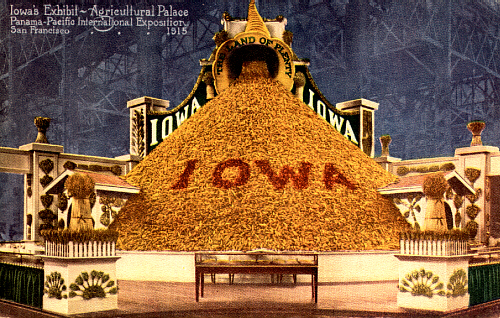
Corn was everywhere in Chicago. Almost all the State Pavilions
featured corn objects. In the definitive
Story of Corn, Betty Fussel tells us how "Iowa's palace was
'pompeiian style,' with a grapevine frieze of purple
popcorn." Other photos showed "corn
draperies, pyramids, corbels, Roman arches, Gothic
arches, buttresses, arabesques" and any other architectural
motif that could be applied to the great grain.
[Fussel, pp. 318-319]
Reid's Yellow Dent was "the corn that changed the face of
the American continent" and was crowned the grand prize
winner in Chicago. This was the first of the
hybrid
corns that swept the American midwest.
[Fussel, p. 71]
Another technology that came into it's own in Chicago is time.
Standardized time is an invention of the modern era. The railroads
needed to coordinate among their stations (and among each other lest
two trains sharing a stretch of track shared it too closely). In
1883, the Naval Observatory agreed to telegraph standard railway
time, a great boon for Western Union, which happened to own the
Self-Winding Clock Company. At the World's Columbian Exposition in
1893, Western Union built a network of 200 clocks, all regulated
from their central pavilion, topped with a 150-foot clock tower.
[O'Malley, pp. 153-154]
Electric powered streetcars hauled people to the Exposition, trains
of 4 cars jammed full of people inside, on the roof, and hanging
off the sides.
[Cudaky, p. 4] Visitors came from all over
the world, but they also came from all over Chicago and Illinois.
The fair brought farmers, school children, and residents from
small towns all over the midwest to Chicago to learn about
culture and technology and to entertain themselves.
[Cronon, p. 344]
One group that came in droves to Chicago were the world's
engineers.
An engineering congress was created in association with the
Columbian Exposition. At the time, engineering wasn't really
considered a real profession, and there was considerable tension
between the working engineers who wanted to build things and
the corporate employers who wanted to build big businesses.
In fact, throughout the next 100 years, technology deployment
would be marked by vacillation between the societies that
represent technology, such as the Institute of Radio Engineers
at the turn of the last century or the IETF at the turn of this
one, and the groups that represented engineering as a business.
[Layton, p. 45]
Back to World Expositions
Sources
Neil Baldwin, Edison: Inventing the Century,
Hyperion (New York, 1995). Very good biography of Thomas
Edison.
William Cronon, Nature's Metropolis: Chicago and the Great West,
Norton (New York, 1991). The story of Chicago's growth from the
Brain J. Cudaky, Cash, Tokens, and Transfers: A History of Urban
Mass Transit in North America,
Fordham University Press (New York, 1990).
Betty Fussel, The Story of Corn
Knopf (New York, 1992). The ultimate story of corn. What
more can we say? A fascinating look at the grain that
changed the world.
Edwin T. Layton, Jr., The Revolt of the Engineers
John Hopkins
(Baltimore, 1986). Looks at the politics of
the engineering societies. Must reading for anybody involved
in Internet standardization who wants to understand why
committees proliferate when there is still real work to do.
Michael O'Malley, Keeping Watch: A History of American Time
Penguin Books (New York: 1990).
|