| Window of Interview:
Date: July 15, 1996
Place: Conservation Office (basement) of Tokyo Metropolitan Museum
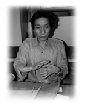
Mr. Handa engages in conservation of oriental paintings and documents both in Japan and abroad using knowledge, techniques, and paper. He not only has a knowledge of paper of all ages and in all places, but also is familiar with new techniques. He has a strong connection with active papermakers across the country. Naturally, all kinds of information on paper gather around him from all over the world. Same as the work, he is sensitive to words, too. He said with a boy's smile,"Kochi is a little too far for me to go with pocket money."
- s the amount of Kochi-made paper used for conservation large?
-
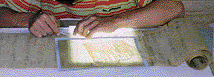 The volume isn't so much. I also use paper made in Mino, Yoshino, Ogawa, and Yame in Kyushu. Nowadays even in Ogawa, papermakers use imported Kozo overwhelmingly, and I have to ask them to use domestic Kozo alone for conservation of cultural assets. Now that it isn't made in Mino any more, Tengujo paper is mostly made in Kochi. However, Mr. Ota is still making paper close to Tengujo in Mino.
If I stick to handmade Tengujo, paper made by Mr. Hamada in Kochi is number one. In some cases, however, the even thinness of machine-made paper by Kashiki Seishi is fine. When I want to press a painting or a document with paper fibers, the very thin paper Mr. Ono makes is useful.
I hope to have a catalog with papers and papermakers' names in it. If I find a proper paper in the catalog, then I can ask the papermaker to make one for me. For instance, there is one Mr. Hasegawa, who came to Mino from other prefecture to make paper. He earnestly tries his best to satisfy my requests. When I am very particular about a certain type of paper, I ask Mr. Inoue in Kochi. Last time I asked him, he went trouble to dry paper on a board according to my request. I was very thankful to him. I want to meet such people as will do better job tomorrow than today. Recently, I have come to know papermakers in paper producing districts. Especially, I am concious of paper made in Kochi now. The volume isn't so much. I also use paper made in Mino, Yoshino, Ogawa, and Yame in Kyushu. Nowadays even in Ogawa, papermakers use imported Kozo overwhelmingly, and I have to ask them to use domestic Kozo alone for conservation of cultural assets. Now that it isn't made in Mino any more, Tengujo paper is mostly made in Kochi. However, Mr. Ota is still making paper close to Tengujo in Mino.
If I stick to handmade Tengujo, paper made by Mr. Hamada in Kochi is number one. In some cases, however, the even thinness of machine-made paper by Kashiki Seishi is fine. When I want to press a painting or a document with paper fibers, the very thin paper Mr. Ono makes is useful.
I hope to have a catalog with papers and papermakers' names in it. If I find a proper paper in the catalog, then I can ask the papermaker to make one for me. For instance, there is one Mr. Hasegawa, who came to Mino from other prefecture to make paper. He earnestly tries his best to satisfy my requests. When I am very particular about a certain type of paper, I ask Mr. Inoue in Kochi. Last time I asked him, he went trouble to dry paper on a board according to my request. I was very thankful to him. I want to meet such people as will do better job tomorrow than today. Recently, I have come to know papermakers in paper producing districts. Especially, I am concious of paper made in Kochi now.
Photo Restoration work with Gampi-shi paper (Wakan Roei-shu)
What is the paper placed on the Byobu (folding screen) which is under restoration now?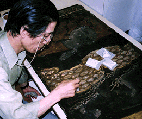 This paper is called Yojo-shi, which is made of polypropylene, a chemical fiber. Pressed with a weight, this paper is put on Nikawa glue so that Nikawa glue won't come off. Unlike Washi, fiber of this paper doesn't stick to a surface of Nikawa glue. This paper is also made in Kochi.
I didn't know function paper is also used in addition to traditional Washi. What is the original use of Yojo-shi?-
Probably, it is used for filters or air cleaners. Also, I have been using chemical paper for disposable body heater. In older times when we didn't have such chemical paper, we used to use handmade Washi coated with persimmon tannin so that we could wash it.
Do you have any episode about restoring paper?-
 Though I stick to handmade paper, I also appreciate machine-made paper if the material is well processed. However, papermakers are more flexible in satisfying our needs. I have known Mr. Okawa of Paper Research Center (present Prefectural Paper Industry & Technology Center) in Kochi for nearly 20 years, and he is kind enough to make some paper for himself when I need only a few sheets of conservation paper. It is very significant that I came to know Mr. Okawa. Even before I met him in person, I asked him to examine Dabi-shi paper which was restored here. Then he answered that the paper doesn't contain scent tree which was thought to be in the paper. Instead, he said it might be Mayumi-shi paper which is recorded in a document. Also, I asked him to examine another Dabi-shi stored in Horyu-ji Temple because it had the same texture as the one we restored. It was also proved to be Mayumi-shi. I knew the word"Mayumi-shi,"but I didn't really know which paper it meant. Then, I asked Mr. Okawa to make paper from Mayumi tree in order to restore Mayumi-shi. Though I stick to handmade paper, I also appreciate machine-made paper if the material is well processed. However, papermakers are more flexible in satisfying our needs. I have known Mr. Okawa of Paper Research Center (present Prefectural Paper Industry & Technology Center) in Kochi for nearly 20 years, and he is kind enough to make some paper for himself when I need only a few sheets of conservation paper. It is very significant that I came to know Mr. Okawa. Even before I met him in person, I asked him to examine Dabi-shi paper which was restored here. Then he answered that the paper doesn't contain scent tree which was thought to be in the paper. Instead, he said it might be Mayumi-shi paper which is recorded in a document. Also, I asked him to examine another Dabi-shi stored in Horyu-ji Temple because it had the same texture as the one we restored. It was also proved to be Mayumi-shi. I knew the word"Mayumi-shi,"but I didn't really know which paper it meant. Then, I asked Mr. Okawa to make paper from Mayumi tree in order to restore Mayumi-shi.
When I took the Byobu (folding screen) of national treasure painted by Ohkyo to pieces, I found it backed with so-called Noriiri paper containing rice starch. I also asked Mr. Okawa to examine it, and asked Mr. Inoue to restore the lining paper to its original form. I wanted to restore even lining paper if possible. I always ask Mr. Inoue very hard task saying for instance,"Please make thick paper for me." Then, he made thick paper by pressing ten different sheets together when they are still wet. Usually, we make thick paper by pasting different sheets together, but Mr. Inoue's way is better because flexible yet durable thick paper can be made.
In what cases of restoration do you use Tosa Tengu paper?-
When I put cut ends together. I have to put restoration paper on the top side of document in the case it has records on both sides. In such a case, a very thin paper like Tengu that doesn't show its existance on a document is preferable.
When I visited St. Catalina Convent in Sinai Peninsula to support photographing, I took handmade paper there with me as I thought it better than machine-made one. When I actually restored a discovered document which had records on both sides, I found marks of paper molder standing out and regretted not having used machine-made paper.
There's a technique called"Sukidame"which came from Europe and helps us restore worm-eaten books and documents. We put a worm-eaten document into a basin, fill its holes with paper fiber by"Tamezuki"method, and restore the document into plain paper. It is good to back such a document with high quality machine-made Tengujo paper.
I hear Washi is also used to restore wall paintings in the Vatican City.
Yes. It is used to get rid of dirt on the frescoes. Washi placed on the frescoes with water absurbs dirt as it dries. Tengujo typed Washi is used to stop paints coming off. Washi is often used to restore oil paintings, too.
Washi is made in various places in Asia.-
An enthusiastic Korean papermaker, for example, prefers to make very natural paper for restoring cultural assets by using materials of his own country. In the case of the Philippines, they make Tengujo paper for mending documents in Thailand. In Taiwan, they grow Tosa Kozo (paper mulberry) and Nasu Kozo in a laboratory. Such Kozo become purified and their fibers become thicker. An excellent paper in China is paper made of"Seitan"tree. Barks are mainly used in the Orient, while hemps or cottons are used in Europe. So, if they try, they can make paper similar to Washi in Asia. In Europe, paper is a substitute. An old paper shows you how hard European people tried to make paper close to parchment.
What are the characteristics of Kochi as a paper procuding center?-
 Basically, since old times no other places have produced all kinds of paper as Kochi. Papermakers in Kochi haven't made same kind of paper, so different types of paper still remain at a higher rate than other places. The feature of Kochi is to adopt features of other places well.
Genta Yoshi wasn't the only person that did so. Even before him, people of Kochi adopted good features of other prefectures. In Edo period when Osaka was a gathering place of paper, a wholesale dealer of paper in Osaka told a local wholesale dealer in Kochi to make such and such paper because the prices of paper made in Echizen or Mino were stable. Then, the papermakers of Kochi did make the paper accroding to the request. It was cheaper to carry paper to Osaka from Kochi by sea than from Echizen by land. In Meiji Period when export industries were encouraged, it was Kochi that became number one in exporting paper. Since papermakers in Kochi have potential skills which meet needs, they can easily adapt themselves to any circumstances. In this sense, Kochi is a great place after all. Basically, since old times no other places have produced all kinds of paper as Kochi. Papermakers in Kochi haven't made same kind of paper, so different types of paper still remain at a higher rate than other places. The feature of Kochi is to adopt features of other places well.
Genta Yoshi wasn't the only person that did so. Even before him, people of Kochi adopted good features of other prefectures. In Edo period when Osaka was a gathering place of paper, a wholesale dealer of paper in Osaka told a local wholesale dealer in Kochi to make such and such paper because the prices of paper made in Echizen or Mino were stable. Then, the papermakers of Kochi did make the paper accroding to the request. It was cheaper to carry paper to Osaka from Kochi by sea than from Echizen by land. In Meiji Period when export industries were encouraged, it was Kochi that became number one in exporting paper. Since papermakers in Kochi have potential skills which meet needs, they can easily adapt themselves to any circumstances. In this sense, Kochi is a great place after all.
|




 Come on! Tosawashifreaks.(Newsgroup)