| Window of Interview:
Date: July 3, 1996
Place: The workshop of"Ageta Kumpu-do"in Kochi City
The name "Kumpu-do"comes from a word of Gembo Osho, a Buddhist priest of Sekkeiji Temple, whom Hiroaki respects as his bosom master. Both Hiroyasu and Hiroaki entered this business at the age of 16. Though their personalities differ at a sight, the same craftsmanship is shown through their works. Among their recent works, the trim and furnishings of"Tosaha no Ie"(Houses of Tosa School designed by Chosui Yamamoto) series using Tosa Washi are notorious. The Ageta family also enjoy hobbies like motorbike rally and photography.
- I hear you use wood and paper produced only in Kochi for Houses of Tosa School.
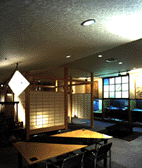 - Hiroyasu: I don't use paper made in other prefectures. Mr. Chosui Yamamoto, who started building Tosa School Houses, sticked to local products and told me not to use paper made in other prefectures. Before that, I mainly used Echizen Washi and Nashio-shi (which is also called Maniai-shi) as Fusuma paper. The paper-maker whose paper I use is particular about the purity of paper, and he uses only materials of best quality produced in Kochi. Since each papermaker makes slightly different paper, I ask the same person to make paper for me. He understands me and cooperates with me well. For Tosa School Houses, each architect uses fixed kind of paper in most cases. Some of the paper are handmade Nisanban Washi and Shibu-gami. Architects who are afraid of fire don't use Washi. The Fire Services Act prevents them from using it. Because Washi is flammable, it cannot be used for a public building. So, in some cases I had to use Washi cloth, which is also flammable, though.
Hiroaki: The most important thing for a mounter is paper fiber. Whether a mounter is skillful or not depends on the fiber condition of a cut end. Especially corners and joint parts require high skills. In order to make a good mounter, good paper is also indispensable. Foundation is most important in everything.
Photo by Ohara design office
Did you take training in Kyoto?
- Hiroaki: Yes, for 16 years. After that, I had a training in Takayama for a while. Bordered by Nagoya, in the western Japan, Kyo-hyogu (Kyoto style mounting) is practiced, while in the eastern Japan, Higashi-hyogu (Eastern style mounting) is practiced. I learned basic groundwork of Kyo-hyogu first, and then Higashi-hyogu. While taking training, I had a chance to mount Japanese paintings stored in Adachi Museum and Ohara Museum.
Tell me about good points of furnishings made of Washi.
- Hiroyasu: We make Fusuma by pasting paper together into many layers and making block of air layers just like the inside of a dirigible balloon ship. When the weather is fine, the air goes out of Fusuma, and when the weather is wet, Fusuma takes in humidity. Since frames of Fusuma themselves have layers of air, Fusuma doesn't let sound and humidity escape. The genuine Washi has strong surface tension. If pulp is mixed in the material, paper will become loose when the weather is humid. A mounter's skill is best shown when he or she papers Shoji, a paper sliding screen. If the sliding screen paper becomes loose when it rains, the mounter's skill proves to be poor.
Hiroaki: Even if it rains, Kochi-made Washi is quite all right as long as a sliding screen is well papered. Kochi-made Washi will become moist and yet durable against humidity. Plastic cloth will have perspiration on it, though.
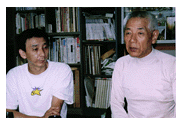 Hiroyasu: If you furnish a house with Fusuma or sliding doors, you will obviously find whether the house is well built or not. Fusuma best fits Japanese people. Once a family was very pleased with my work because their green garden looked more attractive with Fusuma made of Washi. They were so satisfied with it that they didn't even want to furnish their house with Shoji. It's hard to explain, but Washi makes us wonder what's behind it.
Photo Hiroyasu Ageta(right)、Hiroaki Ageta(left)
For example, you use paper for prints on the wall, don't you?
- Hiroyasu: Papermakers usually don't know the purposes of paper they are making. They just make paper that sells well. I once used the best print paper for the back wall of the Buddhist statue when Kokubunji Temple in Nankoku City was rebuilt. The color of the paper was nearly the same as that of plaster and it looked very wonderful.
Do you use persimmon tannin coated paper for repelling insects?
- Hiroyasu: That's one of the reasons, but at present, its brown color best matches cedar wood which is mostly used in Tosa School Houses.
I hear you restore furnishings of old buildings.
- Hiroaki: The method, which is practiced in Takayama, is to take Fusuma apart, wash frames and restore it. I'm going to restore Oka Goten (Oka Palace) in Tano Town which was built in Edo period.
Hiroyasu: In a Samurai family's house in Okawa-suji, which is the only one existing in Kochi, very precious things still remain. Taking old Fusuma and walls away, paper for accounting books and diaries came out. That kind of paper was used because it would last for many years, and now it is a precious thing. It is also good that they used starch glue, as it can easily be resolved.
Hiroaki: In Kyoto, mounters use their original homemade glue. So, it is said that trainees should make glue for three years. The mounters even use 10-year-old glue, as it becomes less sticky and good to use. However, the glue for papering ceiling should be sticky to some extent due to gravitation.
I hear you engaged in the arch ceiling above the stairs of the Art Museum, Kochi.
- Hiroaki: The indigo blue gradation has an image of water rings of the Shimanto River.
Hiroyasu: As we had a clear image of colors, we carefully discussed coloring with the architect.
Hiroaki: Although the architect ordered us to dye paper indigo in Kochi, we dyed it in Tokushima Prefecture because indigo was cheaper there. The surface tension of paper was troublesome. When eighty percent of our work seemed finished, we had to do it again completely from the beginning. It's very difficult to line an arch ceiling with paper in the way that there should be a layer of air between the ground paper and the ceiling. With a layer of air inside, the paper ceiling can be more durable.
I think Washi will match non-Japanese style houses.
- Hiroaki: My cusomer in Tokyo asked me to use Tosa Washi for his Canadian style house. I found Washi really becoming to the house. To match the rough boulding, I used rough paper, which showed a fine taste.
What about the relation between architects and papermakers in Kochi?.
- Hiroaki: I think there should be more opportunities for them to talk with each other in person. Right now I am like a go-between, and even if I tell one side what the other side thinks, there will be a slight gap between them. The architects of Tosa School, however, visit papermakers frequently. I hope more Washi will be used in an ordinary house, too. I am happiest when my customers are particular about paper. Tosa School is a team of professionals with unique characters. Today customers' needs vary from house to house, and each customer sticks to his or her idea. I think now is the time for Tosa School to branch out into other prefectures, and if they do so, they will surely receive favorable reactions.
|




 Come on! Tosawashifreaks.(Newsgroup)